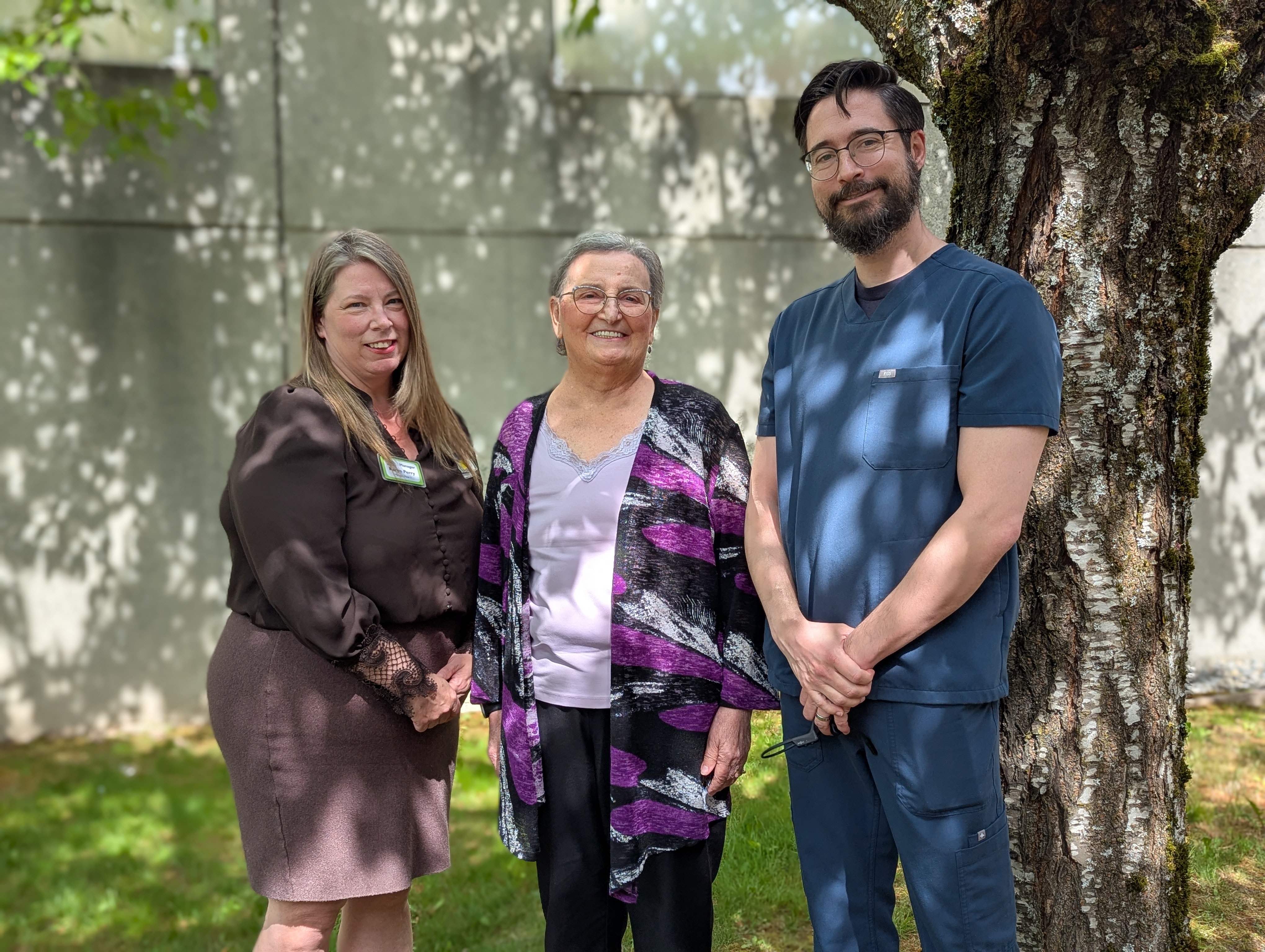
Left to Right: Karyn Perry, Helen Dyck and Dr. Daniel Ontko
Meet Helen Dyck
Parksville resident Helen Dyck was diagnosed in February 2023 with multiple myeloma — a blood cancer that affects bones and is often not curable. While undergoing myeloma treatment, in January 2025, she was diagnosed with breast cancer and needed a mastectomy. Dyck’s myeloma treatment had to be paused while she healed, and when it resumed, it was no longer effective.
Enter a new, highly specialized cancer treatment
In January 2026, Dyck became the first patient at Nanaimo Regional General Hospital (NRGH) to receive new and highly specialized cancer treatment known as bispecific T cell engager therapy. These treatments were first brought to Island Health in 2022 at Royal Jubilee Hospital in Victoria through a partnership with BC Cancer.
NRGH hematologist, Dr. Daniel Ontko, explained that bispecific medications work by identifying markers on cancer cells and directing the body’s own immune system to attack them. While not a cure, they can be very effective for some patients with advanced disease.
Collaborative Treatment Approach
Recognizing how difficult travel can be for patients and families, Dr. Ontko partnered with Karyn Perry, Floor 1 oncology nurse and manager of the NRGH Cancer Care Clinic, and members of Island Health’s cancer strategy research team to bring bispecific treatments to Nanaimo.
“It just made sense,” Perry said. “If a patient needs treatment, that we find a way to provide it.”
To prepare, internal medicine nurses at NRGH received education about cancer care and training on how to monitor patients for side effects.
“Our inpatient staff have really thrived,” Perry said. “They’ve gained confidence in cancer care and built strong connections with our oncology team.”
Patient monitoring
Because reactions to bispecific therapy can be subtle and can happen quickly, careful monitoring is essential. Dr. Ontko said patients receive medication to prevent reactions before treatment begins, followed by frequent assessments throughout the week.
“There are three doses given over five days,” he explained. “The nursing care during that first week is critical.”
If all goes well, patients can return home by the end of the week and continue care as outpatients.
Care closer to home
Bringing services and care closer to home are priorities for Island Health. For Dyck, this made a profound difference for her and her family. “To be able to do this in Nanaimo was a gift,” she said. Her husband could visit regularly, and her daughter could support her without uprooting her life in Parksville.
Since Dyck’s treatment, a second patient has successfully completed bispecific therapy at NRGH, and Dr. Ontko has already identified a third patient who may benefit.
Brighter Future for Helen
For Dyck the results have been remarkable.
“I can get into bed by myself now. I can even put my compression stockings on myself,” she said. “I can do meal prep myself… I have energy. I feel more like me rather than like the person who just wants to go to sleep and not wake up.”
While her cancer is not considered cured, Dr. Ontko said it is now undetectable in testing. Perry added that “this treatment adds quality of life. And it adds quantity of life.”
Krista Boehnert, Specialist, Engagement and Content with files from David Carson, Communications Consultant, Major Capital Projects